Window replacement is one of those home improvement projects that is easy to defer — the windows still open and close, the glass is still intact, and there is always something more urgent competing for the budget. But the signs that windows have reached the end of their useful life are usually visible well before the windows actually fail, and catching them early means replacing on your schedule rather than in response to a crisis. Here is what Augusta homeowners should be looking for.
Fogged or Milky Glass Between the Panes
This is the most unambiguous sign that a double-pane window has failed. The fogging or milky haze you see is moisture that has entered the space between the two panes after the sealant that holds them together has broken down. Once that seal fails, the argon gas fill that provided the window’s thermal insulation has escaped and been replaced by humid air — the window is now performing at roughly single-pane thermal resistance regardless of what the original specification said.
In Augusta’s climate, seal failure happens earlier than manufacturers’ design life estimates suggest. The combination of high summer temperatures, elevated humidity, and the repeated expansion and contraction cycles that Augusta windows go through between July and January stresses sealants more aggressively than the temperate conditions most design life figures assume. Augusta homeowners with double-pane windows installed in the 1990s or early 2000s should inspect every unit for fogging — it is the most reliable indicator that replacement is overdue.
Drafts Near the Frame When Windows Are Closed
Running your hand around the interior perimeter of a closed window on a cold January morning is a quick and reliable test. If you feel cool air moving, the weatherstripping has failed — either compressed permanently and no longer making contact with the sash, or degraded to the point where it no longer forms a continuous seal. In Augusta homes, this test is most revealing on north-facing windows and on any window that gets direct afternoon sun in summer, where the thermal cycling accelerates weatherstripping wear.
Weatherstripping replacement alone is sometimes the right answer for a window that is otherwise sound. But in most cases, weatherstripping failure in Augusta homes is accompanied by frame deterioration, failed glazing seals, or hardware wear that makes full window replacement the more cost-effective long-term choice.
Visible Rot or Deterioration at the Frame
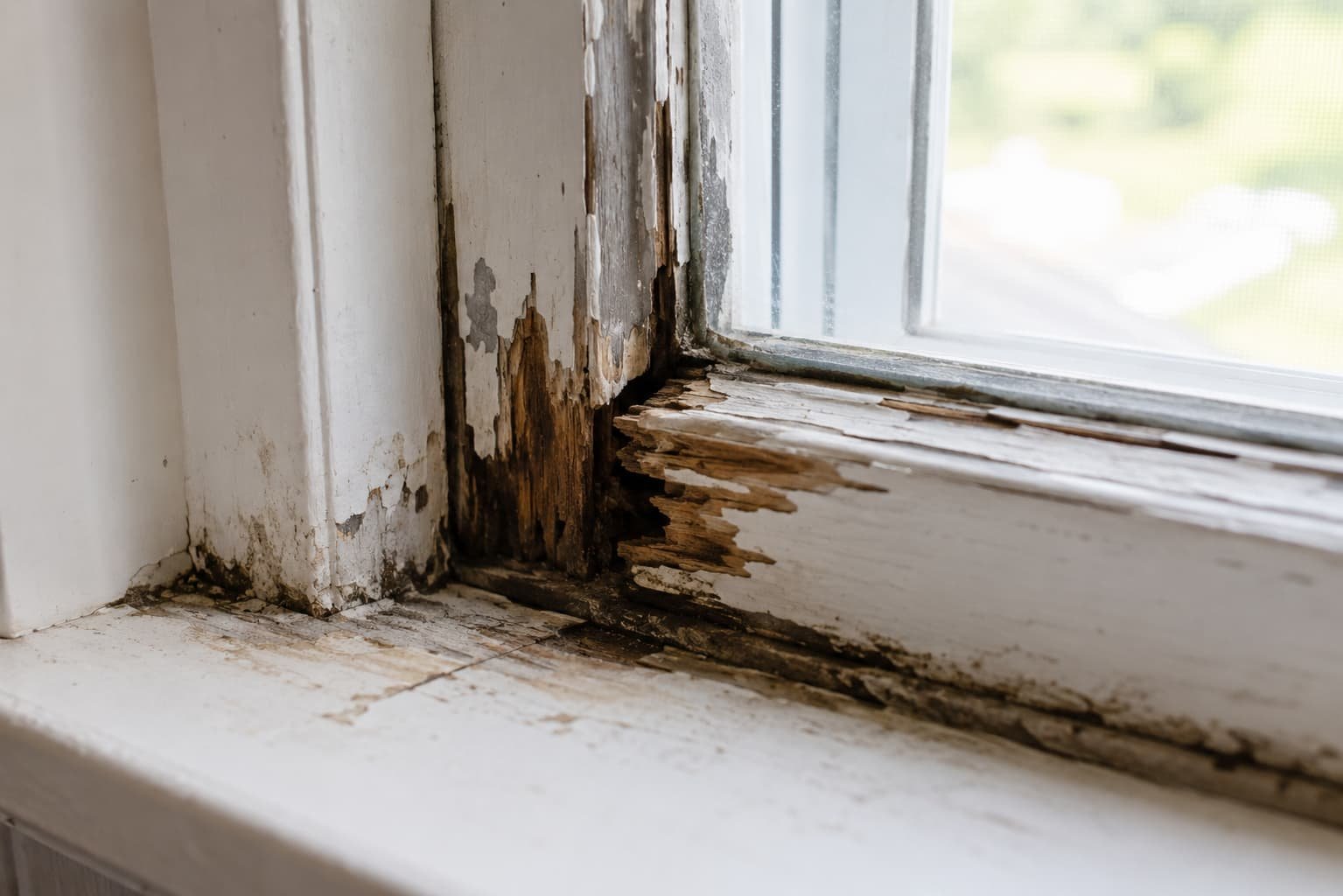
Wood-framed windows in Augusta’s humid climate are vulnerable to rot at the sill and lower frame corners — the areas where water pools and where paint failure exposes bare wood to repeated wetting and drying. Probe the sill and lower frame of any wood-framed window with a screwdriver. If the tip penetrates the wood with light pressure, the frame is rotted and the window needs to be replaced rather than repaired.
Paint failure at the frame — peeling, bubbling, or bare wood visible at joints — is the precursor to rot and a reliable indicator that the frame’s protective envelope has been compromised. Augusta homeowners with original wood-framed windows should inspect frames annually and treat any paint failure promptly. Where rot is already present, replacement is the correct response.
Utility Bills That Climb Every Summer
Windows are responsible for 25–30% of residential heating and cooling energy loss in a typical home. Augusta’s long cooling season — from May through October in most years — means that poorly performing windows have six months per year to drive up electricity bills. If your cooling costs have increased steadily over the past three to five years without a corresponding change in usage patterns or utility rates, ageing windows are a likely contributor.
The effect is most pronounced in rooms with significant west or south-facing glass exposure. A west-facing living room with original single-pane or failed double-pane windows will absorb solar radiation freely on a July afternoon, raising the room temperature well above the thermostat set point and forcing the air conditioning to run continuously to compensate. Replacing those windows with ENERGY STAR rated Low-E units reduces that solar heat gain by 40–70% — a change that is felt immediately and shows in the utility bill within the first full cooling season.
Difficulty Opening, Closing, or Locking
Windows that are difficult to operate — stiff to open, prone to sticking, or that will not lock securely — are not just an inconvenience. A window that does not close fully or lock correctly is a security and weathertightness problem. In older Augusta homes, operational difficulty is often caused by frame warping from moisture absorption, hardware wear, or paint buildup in the channel. In newer homes, it can indicate frame distortion from settlement or from a previous installation that was not level.
Some operational issues can be resolved with hardware replacement or channel cleaning. But where the frame itself has warped or the sash no longer sits squarely in the opening, replacement is the correct solution.
Condensation on the Interior Glass Surface in Winter
Interior condensation — moisture forming on the room-side surface of the glass on cold mornings — indicates that the glass surface temperature is dropping below the dew point of the interior air. This happens with single-pane glass and with double-pane units that have poor edge-of-glass performance due to aluminium spacers or failed weatherstripping. It is a sign that the window is allowing significant heat loss and that interior humidity is condensing at the cold surface.
Persistent interior condensation causes paint and plaster damage at the window surround over time and is a reliable indicator that the window’s thermal performance is insufficient for Augusta’s winter conditions, mild as they are by northern standards.
Exterior Noise That Seems Louder Than It Used To
Sound transmission through windows increases as glazing seals fail and weatherstripping degrades. If traffic noise, neighbourhood sounds, or aircraft from Augusta Regional Airport seem significantly louder inside your home than they did a few years ago, it is worth checking whether window seal failure is the cause. Modern double-pane windows with good weatherstripping attenuate exterior noise meaningfully — failed units do not.
When to Act
The honest answer is that Augusta homeowners who are seeing two or more of these signs on the same windows are past the point where repair is the cost-effective choice. Window replacement with modern, energy-efficient units addresses all of these issues simultaneously — and in Augusta’s climate, the comfort improvement is immediate and the utility cost reduction is measurable within the first full season.
Augusta Window Pros provides free in-home estimates for window replacement across Augusta and the CSRA. We assess every opening, identify which windows are candidates for insert replacement and which need full-frame installation, and give you a written quote that covers everything. For independent performance ratings on every window we install, the National Fenestration Rating Council certifies U-factor and solar heat gain coefficients so you can compare options on an objective basis.
If you are seeing the signs described above, contact Augusta Window Pros for a free estimate. We serve Augusta, Evans, Martinez, Grovetown, Aiken SC, North Augusta SC, and Waynesboro.